New Legislation To Combat Homelessness Passes The First Stage

The Homelessness Reduction Bill has passed through the House of Commons last week. It will now move to the House of Lords for its first reading on the 24 February 2017.

As we reported last month, the new Bill places a duty on local authorities to help prevent the homelessness of all families and single people, regardless of priority need, who are eligible for assistance and threatened with homelessness.

A new duty is also placed on public services to notify a local authority if they come into contact with someone they think may be homeless or at risk of becoming homeless.

The legislation, originally a private members Bill tabled by Tory MP Bob Blackman, has been given wide cross-party support. Homeless charity Crisis thanked ministers and MPs who “came together from across the political spectrum” to move the legislation forward.

The Local Government Minister, Marcus Jones, announced that councils in England are to receive £61 million in funding to help them meet the costs of the legislation (rising from £48 million announced last week). The intention is that the distribution model for subsidy will reflect the differing need across various local authorities, and additional money may be made available for those in high-pressure areas to manage the transition as the new duties take effect.

He further announced that there would be a review of the implementation of the Bill, including the resourcing of it and how it is working in practice, after two years.

Despite amendments put to the Bill by both government and opposition members, the Bill safely travelled through both Report Stage and Third Reading. The Lords are set to have some issue with the commitment to funding after two years, but it is widely expected to pass through there too.

Rough Sleeping On The Increase

The number of people forced to sleep rough on the streets has risen by 16 per in a single year, the latest Government figures show.

On any given night in 2016, over four thousand people were sleeping rough across England. This figure is up from 3,569 in 2015, according to the Department for Communities and Local Government.

Homeless charities branded the new statistics “appalling” and “a national scandal.” The Government, however, said it was piloting new legislation (The Homelessness Reduction Bill) to combat the problem.

The figures also paint a very disturbing picture, showing that the number of rough sleepers with mental health needs has tripled over the last five years.

Homeless charity Crisis said that sleeping on the streets was “no way for anyone to live” and called for urgent action from ministers. Chief executive Jon Sparkes told The Independent: “The number of people sleeping on our streets continues to rise at an appalling rate. Behind these statistics are thousands of desperate people, sleeping in doorways, bin shelters, stations and parks – anywhere they can find to stay safe and escape the elements.”

“Rough sleeping ruins lives, leaving people vulnerable to violence and abuse, and taking a dreadful toll on their mental and physical health. Our recent research has shown how rough sleepers are 17 times more likely to be victims of violence. This is no way for anyone to live.”

But a spokesperson for the Department for Communities and Local Government said the Government was updating legislation to prevent rough sleeping. “This Government is determined to help the most vulnerable in society, which is why we’re investing £550million to 2020 to tackle homelessness and rough sleeping,” he said.

“Homelessness is more than just a housing issue so we are now funding projects in 225 local authorities to help those people at risk of becoming homeless, already sleeping rough or those with complex needs, to get back on their feet. We are going even further and changing the law by backing Bob Blackman MP’s Bill.  This will mean that people across the country get the help they need to avoid becoming homeless in the first place.”

Domestic Abuse Is A Major Cause Of Homelessness In Liverpool

A quarter of the homeless people in Liverpool have nowhere to live because they are victims of domestic abuse, according to a local charity.

Jacqui Nasuh, founder of the Merseyside Domestic Violence Service, told the Liverpool Echo: “On average a women will be abused 38 times before they report domestic violence. The biggest problem with women not reporting domestic abuse is that they are afraid that they will have their children taken away.”

Another common feature of domestic abuse is the aggressor tries to control the victim, which means that it often goes unreported. “All the men have told us that if they had somewhere to go when things flare up they would leave the house,” said Jacqui. “Instead of having just female shelters we need to have places that men can go so we can keep families in their homes as much as possible.”

The problem of homelessness is getting worse, with 25% more people needing housing in 2015-16 compared to 2010-11, the majority of whom are women.

According to a review of homelessness carried out by Liverpool city council, 12,000 domestic abuse-related calls are made each year and the numbers are rising. Domestic abuse is six times the national average in North Liverpool and around double the national average in South Liverpool. More than 80% of people made homeless by domestic violence were women. Some are supported to stay in their home if the abuser has been arrested or does not live with them.

Councillor Frank Hont was critical of the coverage of rough sleeping which he claimed does not represent the majority of homeless people. In 2015-16, the housing options team was contacted 7,000 times, yet there are only 74 recorded rough sleepers in Liverpool. “When most people think of homelessness they think of rough sleepers because this is the visible end”, he said. “In really difficult times we’re still spending £10m on homelessness out of a tight budget because it’s such an important issue.”

Each year £3.1bn of public money is spent on services for domestic abuse such as the criminal justice system, social services, health, housing and legal aid.

More Cuts Will Increase Homelessness Say Charities

Services to help the homelessness are gearing up for more cuts to local authority budgets and predict a surge in the number of rough sleepers and more pressure on overstretched NHS and social care services.

According to a report in The Guardian, councils across the UK are preparing to close housing support services, refuges and sheltered housing, as they struggle to meet the demands of a fresh round of multimillion-pound budget cuts from April.

In Sunderland, for example, the housing support budget for homeless people is being cut to zero. The Salvation Army, which runs a local hostel, said the council faced hard decisions. “They have closed libraries and children’s centres and they are now having to look at cutting support to the most vulnerable people.”

Sunderland council said in a statement: “Because of budget cuts and the government’s austerity programme, the council is reviewing and remodelling many services.”

Housing support includes services aimed at helping people at risk of homelessness – such as ex-offenders, people who are mentally ill, substance users, or those with learning disabilities – stay in stable accommodation, as well as the provision of hostel beds and homelessness outreach initiatives.

In Norfolk, £5m worth of cuts to housing support services – around 55% – proposed by Norfolk county council from April would drive up homelessness in Norwich, which is already reporting record numbers of people sleeping rough on the streets.

Derek Player, the general manager of St Martins Housing Trust, a homelessness charity in Norwich, said the county council’s proposals would increase homelessness and divert more people into high-cost social care and NHS services.

He said: “I have every sympathy with councils who are charged with really difficult choices. But the services they are proposing to cut are the services that divert people away from expensive forms of social care. We are easy targets, but we should be invested in, not disinvested from.”

Alan Waters, the leader of Norwich city council, said the city faced a “perfect storm” of shrinking council budgets, welfare cuts and rising rents. Spending on housing support in Norfolk had halved since 2010, and Norwich anticipates a 30% increase in demand for homelessness services.

Bill Borrett, the chair of Norfolk county council’s adult social care committee, said the council would continue to protect the most vulnerable residents. “We are clear that our priorities are preventing people from getting to the point of crisis and helping those most in need.”

Local authorities across the UK are putting the final touches to budgets for 2017-18, which will bring in another round of cuts. They follow £20bn savings made between 2010 and 2015, a 40% real-terms reduction to their core government grant, according to the Local Government Association.

However, a government spokesperson said: “This government is committed to supporting the most vulnerable in our society. That’s why we’ve given councils almost £200bn to spend over the lifetime of this parliament, so they can deliver services that local people need and ensure our country works for everyone.

“We’ve also announced an extra £900m for social care in England, meaning councils will have a total of £7.6bn to spend over four years. Our £550m investment to tackle homelessness includes specific funding for those areas facing the greatest pressures.”

Local Photography Student Brings Rough Sleepers Into Sharp Focus

Wirral student Elizabeth Pennington, 20, has photographed homeless people across the country for her project Hear My Voice, which she hopes will raise awareness of the issue.

Elizabeth, who studies at Sheffield Hallam University, said the project had ‘opened her eyes’. She told the Liverpool Echo, “When I first started approaching people, I felt quite nervous. It made me realise I definitely had my own preconceptions and prejudices and that’s what we all need to break down. The people I met were so open and honest with me,” she said.

“It was interesting to see the reactions of people walking past – at times it felt like I was being looked down on and some seemed unsure of my intentions towards the people I was photographing. It’s been a real education for me.”

“Being from more of a rural area, homelessness wasn’t really apparent to me growing up – so I became more aware of it whenever I would go into Liverpool city centre. It’s an issue that isn’t talked about enough in the media, so I want to try and raise awareness in anyway I could.”

One Liverpool man she photographed, Paul (41), told Elizabeth of how he had lived in South Africa and Spain for many years, working as an English teacher. However, he lost everything after becoming addicted to drugs.

His friend Marcel, 29, from Pensby in Wirral, had a successful career in journalism, working in the USA and Germany up until last year, when he entered rehab for drug addiction. He now lives on the streets and says he faces daily attacks from others in the homeless community for “being university educated”. He added: “I had everything and now I have nothing. I’m living in a haze.”

However, Elizabeth also met a woman called Cathy, 40, who lives on the streets with her husband John. She told Elizabeth that a lot of people think that everyone who’s homeless is addicted to drugs and alcohol, but she said that’s simply not true.

Asked if she felt she was treated differently by passers-by, because she’s a woman, she told Elizabeth: “No, it’s just the same – we still get ignored most of the time, regardless of gender.”

Elizabeth began Hear My Voice last summer and is hoping to hold an exhibition on Merseyside soon.

You can see more of her work by going to her website http://lizzypennington8.wixsite.com/epphotography/hear-my-voice

A Little Kindness Goes A Long Way

A young couple who were helped out by a homeless man praised his kindness and repaid him with hope for a new life.

Charlotte Ellis says she and boyfriend Taylor Walden were stranded at Covent Garden Tube station when ‘Joey’ offered her his coat and duvet. In return, the pair took him back to her family home in Essex and, after five days, she says he has a job and is off the streets.

“Sometimes, all someone needs is someone to give them a little bit of their time,” she wrote on her Facebook page. “All he needed was someone to have faith in him and to help be that stepping stone to make a difference to someone’s life.”

“Joey is the most amazing, caring and incredible human that we have ever met and I’m so blessed to have been a part of getting him off the streets.”

Ms. Ellis says that on Wednesday, January 4, she and Mr. Walden were waiting for morning services at Covent Garden to resume after missing the last Tube because “in our drunken state we had got confused and had missed the last train”.

Because she looked so cold, Joey asked Ms. Ellis if she wanted to borrow his coat and duvet and they began chatting. “There was just something about him that was so sincere, I couldn’t leave him out there on his own,” she said. “No one deserves to be out in these conditions. I’m not saying that you should trust everyone you meet on a street corner, but who exactly should you trust?”

She refused to leave without him, and the three took a taxi back to Essex, before he slept in her Billericay home. Over the next five days, she, and three other friends, took him for Indian food, “had his hair cut”, gave him a mobile phone, gave him clothes and played Playstation with him.

Ms. Ellis told The Mirror: “We’re absolutely astonished and overwhelmed that my post went viral, all I hope is that people think to give people like Joey a little bit of their time. That’s all I wish for.”

Two Families In London Are Made Homeless Every Hour

The housing charity Shelter predicted that 1,260 families in the capital will lose their home in the next month and 7,370 over the next six months – the equivalent of a household every 34 and 35 minutes respectively.

Shelter based its predictions on government homeless statistics and said more affordable homes must be built. Latest figures for the capital show that there are 43,820 homeless families, including 88,040 homeless children, in temporary accommodation.

Graeme Brown, Shelter’s interim chief executive, said: “Every day, we speak to homeless parents desperate to escape cramped emergency accommodation, where the whole family is often forced to share one room. With a chronic lack of affordable homes and welfare cuts continuing to take their toll, we expect to hear from even more families.”

The most recent government figures, from July to September last year, show that the number of households in temporary accommodation in Britain rose nine per cent on the same period in 2015. Of the 4,580 families accepted as becoming homeless in London, 40 per cent lost their home after a private tenancy came to an end.

London Mayor Sadiq Khan recently set out new planning rules to ease the housing crisis, by speeding up the building of more affordable housing, alongside £3.15 billion to support construction of 90,000 affordable homes.

Fears Mount For Fate Of Rough Sleepers As Snow Forecast And Temperatures Drop

The weather forecast for the North West in the next few days shows snow is about to hit and temperatures to drop below freezing, raising concerns for those sleeping rough on the streets of Merseyside.

The Met Office is predicting a snowfall across most of Britain on Thursday, with high drifts in rural areas. A cold northwesterly airstream will be in place throughout Thursday bringing occasional snow showers. Around 2cm of snow is possible at low levels, with up to10cm on high ground above about 200 m.

This comes after a man, said to be in his 40s, was found in a gateway in Victoria Street in Liverpool city centre last Thursday. He was taken to the Royal hospital following concerns for his health but, sadly, later died. Police told the Liverpool Echo that his death is not being treated as suspicious and the details have been passed to Liverpool’s Coroner’s Court. The ECHO understands he had pre-existing medical conditions.

His death came a night after temperatures plummeted below freezing across Merseyside, sparking concern for rough sleepers and homeless people across the region. According to Liverpool Council around 15 to 20 homeless and rough sleepers remain on the city’s streets, but this figure could be much higher.

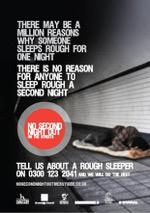
Last month, Liverpool Mayor Joe Anderson ordered the city’s cold weather shelter, operated by The Whitechapel Centre, to open on any night where the temperature is forecast to drop below 2°c. Previous guidance was for the Crown Street centre to open at night when the temperature dropped to freezing. That move followed a campaign to promote the No Second Night Out helpline, to make sure those sleeping on the streets receive the support and help they need.

If you are concerned that someone might be at risk sleeping rough, call 0300 123 2041 or email info@whitechapelcentre.co.uk . Outreach workers from the Whitechapel Centre will provide a rapid response to support rough sleepers reported to the charity.

No one should have to spend a single night out in this deadly weather, so spare a thought and make the call. It could save a life.

Venus Launch New Support Programme

Step Together is a new programme to be delivered by Venus to support women and young women who have had one or more children permanently removed into care.

The programme will run initially for 5 years and will provide support to 150 women over this time to address their needs to avoid what is – or could become – a recurring cycle. Many issues contribute to this cycle (such as domestic abuse, substance misuse, mental health and previous trauma) and half of these women are aged 24 and under. A study over a six-year period (2007 to 2013) showed that just over 7,000 birth mothers experienced nearly 23,000 babies and children taken into care.

Whilst care proceedings are active there are usually many services involved with the family. However, once the children have been removed from the mother’s care she is left with little or no support at a time when she is likely to be alone and depressed experiencing feelings of anger, loss and regret. At this point women are even more vulnerable to increased risk-taking and an downward spiral of mental health.

However, this is also a point at which appropriate interventions could engage birth-mothers in an intensive support programme which will stabilise their lives and work towards addressing their previous trauma and overcoming the complex range of issues and barriers they face. This is what Step Together aims to do by providing individual support and therapy through a co-designed support plan enhanced by the additional services below.

  • Sexual health and contraception support, information and treatment will be provided every three months.
  • Support to attend weekly substance misuse treatment and support.
  • Domestic violence support to manage safety-planning, where these issues are priorities.
  • Incredible Years or Triple P Parenting individual or group sessions.
  • Weekly counselling sessions using a model appropriate to individual needs and therapeutic group work.
  • Safer, Healthier and Empowered training course.
  • Participation in project design and delivery.
  • Home management support including life skills, cleaning, organisation and routines.
  • Homeless prevention and housing related support and advocacy.
  • Health support, including GP registration and liaison and mental health management.
  • Financial resilience support, including benefit maximisation, budgeting, avoiding high interest and unregulated lending, credit unions and access to grants for household goods.

This project was launched at Venus in October 2016 but, due to the holistic and intensive nature the programme, is only expected to work with 20 women in the first year. This number is expected to rise by 5 each year to a total of 40 in year 5. We do hope we can do more but, obviously, there will be more demand than capacity so we will be hoping to liaise closely with referring agencies to identify the most appropriate referrals.

If you are interested in referring to our Step Together project, please contact Venus on 0151 474 4744, or make a referral through their website www.venuscharity.org

An Act Of Kindness Helps Reunite A Family

A local man built a mobile homeless shelter for people sleeping rough on the streets of Cardiff at Xmas – but also helped to reunite a family.

Mark Burgess spent £350 making a temporary home for people living on the street. The shelter is on wheels so it can be moved around and contains a fire alarm, light, insulation, ventilation and a lock. Mark said he decided to build the cabin following the recent cold nights in a bid to help those on the street stay dry and warm.

On Xmas Eve Mark took the mobile shelter into the city centre, looking for someone who could make use of it. He came across a couple, Sion and Sherrie, who were sleeping rough with their dog, Taff.

Mark said: “I walked around Cardiff on Xmas Eve and when I got to St Mary Street I saw a couple with a dog. I talked to them for a while and even though I had built it for one person they seemed keen so I took the guy to see it.”

‘He had promised her they would be off the street by next Christmas,’ Mark explained. ‘He was really happy about the shelter.’

But after Sion’s sister saw the initial report in The Metro, she got in touch with Mark. She said that now they had an idea where Sion was their mum wanted to come to Cardiff to look for him.

“I told her a few places he had been spotted, saying it really wouldn’t be difficult to spot them,” said Mark. “Since then Sion’s mother came down to Cardiff, and has taken them back to Swansea.”

Mark was also informed that Sion has three children who are being looked after by his mum – and all of them have been reunited and are now living together in a caravan owned by Sion’s mother.

“I couldn’t believe it,” said Mark. “It was so nice to update everyone who had shown an interest in the story to let them know that Sion is back with his family with a roof over their head.”

(Picture: BPM)