Liverpool Gets An Extra £1 Million To Prevent Homelessness

Liverpool city council will spend £948,000, over two years, from a Government grant to help prevent people from ending up in a position where they are at risk of losing their home.

According to the Liverpool Echo, a report to the council this Friday (August 4th) will recommend using the money to increase the number of staff in the Housing Options Service that helps people find new accommodation, and providing more outreach support for vulnerable people. This is in addition to the council’s existing budget of £10.8m for homelessness, which is spent on a range of interventions including temporary accommodation and housing as well as help for rough sleepers and people with complex needs.

But while welcoming the additional cash, cabinet member for housing Cllr Frank Hont reiterated the complexities of Liverpool’s homelessness issues – which includes so-called “professional beggars” operating in the city centre, who he says are “conning” people out of money.

Mr. Hont told the Echo: “The most visible sign of homelessness is rough sleeping but this is just one aspect of homelessness and a small minority of the 6,000 households that we help every year. The vast majority of people on the streets have turned down the offer of temporary accommodation, usually due to complex needs such as substance misuse or mental health issues. “In addition, we know there are also professional beggars who come to Liverpool to con shoppers and workers out of their hard earned money by pretending to be homeless.”

“This is a hugely complex issue but one we are resolutely focused on tackling, whether it is identifying and helping those who are at risk, working with partners such as the Whitechapel Centre to help rough sleepers into new accommodation or encouraging people to contact us through the No Second Night Out programme if they see someone sleeping on the streets.”

Councillor Paul Brant, health and social care chief, said: “We have taken great care to protect homelessness services from reductions in funding despite the huge cuts that we have faced in recent years but it is a struggle due to welfare reforms and austerity which have left many more people vulnerable.”

The grant comes in two lots, with £448,800 in 2017/18 and £499,634 in 2018/19. “We will be using this additional funding to prevent people from becoming homeless rather than picking up the pieces when somebody has lost their home and I would like to thank our staff who have worked hard to secure this valuable extra money,” said Cllr Brant.
Students Set Up Project To Help Homeless Women

A group of students have pledged to spend their summer helping homeless women in the North East.

According to a report in Chronicle Live, the friends from St Wilfred’s College in South Shields have launched ‘NE Flow’ and aim to collect donations of sanitary products to give to women in the region who are struggling. The six friends have already raised money for the project with a bake sale at school and through a JustGiving page.

Lily Burns and her pals came up with the idea after a chat in their sixth form break. She said: “Me and five of my friends felt like we wanted to do something to help the community. We realised that sanitary products aren’t as accessible for homeless women or for women who are struggling with money. For some people they will have to choose between a meal or buying these products and that is not okay.”

The girls plan on working with local homeless shelters and food banks to give out packages of products to women who are most in need. Lily added: “It has made us realise how fortunate we are. We all feel it is something that we just take for granted, we just go into a shop and buy them but for some people that is not an option. We feel quite strongly that everyone should have access to these things, no matter what their circumstances.”

Lily is working with her friends Alice Sleight-Holme, Grace Gibson, Amber Scott, Eden McLaclan and Erin Moffatt, all aged 17, and says the teachers at St Wilfred’s College have been very supportive. “Some of the teachers have made donations, I think they are quite impressed that we are doing this.”

For more information on how to help, visit www.facebook.com/NEflowUK/

Rough Sleepers Could Be Fined £2,500!

In a bizarre turn of events, rough sleepers in Oxford have been warned they must remove their possessions from doorways or face fines of up to £2,500.

Community protection notices were placed on homeless people’s possessions last week, ordering that they must remove their belongings or be prosecuted for “unreasonable” conduct. The notice, issued under the legislation designed to tackle anti-social behaviour, accused rough sleepers of “causing an obstruction […] that may constitute a hazard” and leaving their belongings unattended on any land that is “not rightfully” theirs without written permissions from the landowner.

It warned that if people with no fixed abode failed to comply by the following morning they would be committing an offence that could lead to court action and a maximum fine of £2,500.

Oxford City Council said the presence of the bags was blocking fire escapes in a particular part of the city and therefore posing a risk to those working inside, saying lockers are available for homeless people to store their belongings. But local Green Party Councillor David Thomas told The Independent the rough sleepers affected struggled to find a viable alternative, with only a “limited” amount of storage space currently provided by the council.

He claimed using legislation designed to prevent anti-social behaviour against homeless people was a “disproportionate” use of the council’s power. “That legislation is designed to tackle anti-social behaviour, not to harass the homeless over their bags. It’s disproportionate power. People get confused between the definitions of annoying and anti-social,” said Mr Thomas.

“Homeless people affected told me they understood it was a safety issue, but they don’t have a viable alternative on where to store their things. In the local night shelter there’s very limited lock up space, but nowhere near enough to give people dignity. “A few months ago the council did start a discussion about providing more lock-up space, but nothing has happened since.”

The action follows a controversial Public Space Protection Order (PSPO) introduced in 2015, which was designed to tackle “persistent types of anti-social behaviour”. It has been condemned for its frequent use in targeting the homeless.

Mr Thomas said that amid growing rates of homelessness in the city, such orders against rough sleepers failed to tackle the root of the problem. “Oxford City Council has a history of using anti-social legislation against rough sleepers. They’re a bit quick off the mark, and this is a very easy piece of legislation for the council to administer,” he said. “Homelessness is a rising problem in Oxford, and the true figures are often underestimated. It’s a bit like a cat and mouse game, the council keeps moving them on and it’s a waste of time and resources.”

Claire Dowan, chief executive of local charity Oxford Homeless Pathways, which works with a number of rough sleepers in the area, said viewing homelessness in the city from an “anti-social” perspective failed to look at the root causes.

“My questions is: why are these dispersal orders needed? We’re talking about a very vulnerable client group, and what needs to be addressed is how we can accommodate and care for them and address some of those social issues,” she told The Independent. “It should be about the root causes. We’re looking at vulnerable people who often don’t have any alternative and need help. If you look at homelessness from the perspective of anti-social behaviour, you aren’t looking at the real issues behind it.”

Nobody has yet commented on how a homeless person will be able to pay a £2,500 fine!

Homeless Children Hit Hardest As Evictions Soar

The number of homeless children in temporary accommodation went up by a third whilst evictions increase, according to reports.

The Local Government Association (LGA) said councils are providing temporary housing for around 120,540 children with their families – a net increase of 32,650 or 37% since the second quarter of 2014. It said the increase equates to an average of 906 extra children every month.

According to a report in The Guardian, the LGA said placements in temporary accommodation can present serious challenges for families, from parents’ employment and health to children’s ability to focus on school studies and form friendships. The LGA, which represents 350 councils across England, said the extra demand is increasing the pressure on local government. It said councils need to be able to build more “genuinely affordable” homes and provide the support that reduces the risk of homelessness.

This means councils being able to borrow to build and to keep 100% of the receipts of any home they sell to reinvest in new and existing housing, the LGA said. Council leaders are also calling for access to funding to provide settled accommodation for families that become homeless.

Martin Tett, the LGA’s housing spokesman, said: “When councils are having to house the equivalent of an extra secondary school’s worth of pupils every month, and the net cost for councils of funding for temporary accommodation has tripled in the last three years, it’s clear the current situation is unsustainable for councils, and disruptive for families.”

“Councils are working hard to tackle homelessness, with some truly innovative work around the country – and we now need the Government to support this local effort by allowing councils to invest in building genuinely affordable homes, and taking steps to adapt welfare reforms to ensure housing remains affordable for low-income families.”

This comes in the same week a report from the Cambridge Centre for Housing & Planning Research reveals the number of renters being evicted from their homes is at record levels, with more than 100 tenants a day losing the roof over their head, according to a shocking analysis of the nation’s housing crisis. The spiralling costs of renting a property and a long-running freeze to housing benefit are being blamed for the rising number of evictions among Britain’s growing army of tenants.

According to a study, for the Joseph Rowntree Foundation, more than 40,000 tenants were evicted in 2015, up by a third since 2003 and the highjest on record. The study found that changes in welfare benefits have combined to make rents unaffordable to claimants in many areas. Housing benefit was no longer covering the cost of renting in some cases, with average shortfalls ranging from £22 to £70 a month outside of London, and between £124 and £1,036 in inner London.

Housing benefit has not risen in line with private rents since 2010, and a current freeze means the rates paid will not increase until 2020.

The full report can be downloaded here: http://www.cchpr.landecon.cam.ac.uk/Projects/Start-Year/2016/Poverty-evictions-and-forced-moves/OutputTemplate/DownloadTemplate

Homeless Reduction Act Comes Into Law

Having gained royal assent in April the Homeless Reduction Act is poised to have a major bearing on how local authorities tackle one of this decade’s biggest social issues.

Compared with seven years ago, more people are sleeping rough, more are in temporary accommodation and, it’s thought, more people are ‘sofa surfing’ or simply coping without a permanent home. The Act requires councils to now intervene sooner if anyone is threatened with homelessness and do more to help everyone without a home, not just those classed as ‘priority need’.

At the heart of the legislation are two new duties. A preventative duty requires councils to assist anybody who is threatened with losing their home in the next 56 days (up from 28 days), while a relief duty requires councils to help anyone without a home to find one. Public authorities must refer to a council any client they work with who is homeless or at risk of it.

At present, most support is given to ‘priority’ cases such as pregnant women, families with dependent children or anyone fleeing their home due to violence. These are normally offered temporary accommodation – typically hostels or bed and breakfast – until a permanent home is available.

In future, councils will still be able to withdraw support if people fail to co-operate and do not show they are making their own efforts to find a home. There is also still no guarantee that even priority cases will be offered a home with a social or private landlord. But there appears to be a renewed willingness to accept more needs to be done on the part of government (which is offering councils £61m over two years) as well as local authorities.

Last December, the number of households in temporary accommodation in England stood at 75,740 – up 10% on the previous year. The most recent rough sleeping figures, based on local authority headcounts and estimates last autumn, showed 4,134 people sleeping rough – more than double the number in 2010.

Supporters are quick to stress the new measures will not solve homelessness overnight. Alice Ashworth, senior policy officer at the housing charity Crisis said: “The act provides support for people who are currently cut out of the system.” According to Ms. Ashworth, the Act should mean people are helped to mediate with a landlord or their family, rather than sent away ‘to sleep on the streets.’ She added: “Some councils tell people to come back when they’re actually homeless. They wait until people turn up at the council with their suitcases.”

A report last year by the House of Commons communities and local government committee identified three main reasons for the increase in homelessness – lack of social housing; high private sector rents; and welfare cuts.

But Steve Bullock, Labour mayor of Lewisham and executive member for housing at London Councils, has little doubt that, by offering £61m over two years, the DCLG has seriously underestimated costs. Lewisham estimates the extra burdens will amount to £2.4m in its borough alone. “We share the ambition of dealing with these problems on a day to day basis,” he says. “Our anxieties are around costs.”

Most homes built by councils and housing associations since 2013 are for ‘affordable rent’ (up to 80% of market rents) and are unaffordable for many households. Last year, just 6,800 homes were built for social rent in England compared with 39,560 in 2010/11.

Bullock believes all governments must share the blame for the shortage of social housing and subsequent reliance on private landlords. “You can’t excuse the last Labour government but it’s an issue that’s not been addressed properly since 2010,” he says.

The new duties, which mirror changes made in Wales two years ago, may not be introduced in England until early next year. Guidance is awaited from the DCLG, while 28 trailblazer authorities are being funded until 2018/19 to trial the new duties.

Andrew Walker, researcher at the Local Government Information Unit, says they will pose an enormous challenge for councils with success depending greatly on resources. “You need more staff available. You need a different interface with the public,” he says. “It means using data more intelligently.”

Faye Greaves, policy and practice officer at the Chartered Institute of Housing, says the Act has the potential to reduce the numbers receiving little or no help, especially single people, and will introduce consistency across local authorities. The issue of whether somebody has made themselves homeless intentionally will not kick in until much later. “People who might have been turned away with a list of hostels and private landlords will have a legal right to more help and more consideration,” she adds.

Those expecting significant results may have to be patient, but there is at least the prospect of fewer people relying on a sleeping bag in a shop doorway. “This is an act to reduce homelessness,’ says Greaves. ‘It’s not an act to eliminate it.”

Housing First Launched In Liverpool

Plans are being made to get long-term rough sleepers into their own home as quickly as possible by adopting the Housing First approach.

Research, commissioned by Crisis with funding from the UK government and the Housing First Europe Hub, looked at the potential costs and benefits of rolling out Housing First across the Liverpool City Region, drawing on existing evidence as well as new statistical analysis and interviews with nearly 100 professionals and 79 people with experience of homelessness. The recently released report ‘Housing First Feasibility Study For The Liverpool City Region’, shows how Housing First could deliver savings for cities and local authorities right across the UK, with potential savings for Liverpool City Region estimated at between £1.18m and £4.02m per year by 2023/24.

The report says the current system is failing some of the most vulnerable homeless people, who often struggle with the rules and conditions, stress, and lack of security in hostels, and who need higher levels of support as a result of poor mental health, substance misuse, physical or learning disabilities or a history of offending. In some cases, rough sleepers in the Liverpool City Region had had as many as 10 hostel placements in the past four years.

The Housing First approach aims to give people a stable, secure home of their own as soon as possible and to build personalised support around them, placing an emphasis on individual choice, respect and citizenship. This approach is likely to be more effective in supporting the most vulnerable and long-term rough sleepers to stay in a rented home compared to existing services in Liverpool City Region. The report also recommends that it should be used as part of a wider ‘housing-led’ system that addresses the needs of all homeless people and places emphasis on preventing people from becoming homeless in the first place.

But the idea is not without its critics. Joe Halewood, who writes an online blog (speye.wordpress.com) says: “All variants of the Housing First model require suitable properties which are almost exclusively 1-bed properties to be available. We know that 1-bed properties are in short supply as the bedroom tax and the inability to downsize has proved.”

“More significantly we have actual data in the English Housing Survey which reveals that 28.2% of all social housing has 1 bedroom. Yet we also know that the Liverpool City Region areas have a pitifully low proportion of 1-bed properties at 16.83% in Wirral, 16.72% in Liverpool, 15.03% in Knowsley, 14.96% in Sefton and just 12.41% in St Helens and that data is in the Statistical Data Return provided to the social housing regulator.”

“Housing First in the LCR area cannot work on a large-scale basis because of this. It possibly can on a smaller scale though only a few limited housing associations may take part as only a few of them have anything over 10% of their stock as 1-bed and note there are no council landlords in the LCR area.”

“It could work on a shared accommodation basis with, for example, two persons sharing a 3-bed property for which the LCR area has a surfeit of supply with the LCR areas all having more than 50% of total properties as 3-bed compared to the English national average of 36%. That shared model stacks up far better financially for social landlords however there is very little appetite for shared housing by HA’s for low risk general needs tenants so we must assume there will be even less for higher perceived risk tenants such as those who are homeless.”

You can download the report ‘Housing First Feasibility Study For The Liverpool City Region’ here: https://www.crisis.org.uk/ending-homelessness/homelessness-knowledge-hub/housing-models-and-access/housing-first-feasibility-study-for-liverpool-city-region-2017/

Use It? Lose It! – Smoking Cannabis At Home Could Lead To Evictions

A group of housing providers on Merseyside have teamed up with local authorities to combat cannabis use in rented accommodation. They have launched a campaign – ‘Use it? Lose it!’ – to warn tenants they risk being evicted from their home if they use or grow the illegal drug.

Registered housing providers including Riverside, Liverpool Mutual Homes (LMH), Plus Dane, Adactus, Cobalt, One Vision, Pier Head, Contour, Your Housing and South Liverpool Homes (SLH) are working alongside Liverpool City Council, Merseyside Police and Merseyside Fire & Rescue Service in the crackdown. Posters and leaflets will be distributed to tenants across the area as part of the initiative, which follows a series of house fires in the region caused by cannabis farms.

Donna Kelly, regional director at LHT, is leading the campaign and says: “Cannabis use in rented properties, particularly those with communal areas, can be a real nuisance to residents. Not only is it illegal, it is also often linked to other anti-social behaviour. While we are always here to offer support to residents with drug problems, we are also concerned about the impact of cannabis use on the wider community.”

“This campaign sends out a clear message to those using illegal drugs: we take this matter very seriously and will take the appropriate action to protect other residents – including eviction.”

Mark Wiggins, Liverpool local policing superintendent, adds: “Growing cannabis is not a victimless or low level crime and Merseyside Police is committed to bringing the people responsible to justice. Our communities can help us stop these groups, who are only interested in making money from turning houses and flats into potential death traps.”

“Nobody wants to live next door to these houses and we would ask that if you believe someone is using a property for this purpose, please tell us so we can take positive action and find those responsible for setting them up.”

But, according to a report in The Mirror, in the small print of every tenancy agreement there is a line that could see you evicted if you’re caught in possession of cannabis. The line: “We will not tolerate anti-social behaviour,” goes beyond vandalism or noise pollution.

The decision to smoke cannabis, according to the Association of Residential Letting Agents (ARLA), breaks three standard terms and conditions which are common to most tenancy agreements. These include: “Not using the property for illegal or immoral purposes; not consuming illegal substances; and, subject to the landlord’s consent, not smoking in the property.”

Charlotte Herring, from the UK housing association, said: “If we suspect cannabis smoking we will alert the police, in case it is part of a wider investigation, and investigate ourselves. In general, if we prove cannabis smoking, we will both give a warning and offer support to help the resident to stop.” She added that legal action is a ‘last resort’.

If you are caught, your landlord has the right to contact neighbours and housing officers for advice, issue a formal warning, notify the police, refer you to a support group, and ask the courts for a conviction order. Neighbours are encouraged, if they wish to report it, to speak to a housing officer (if the property is council-owned), or the landlord directly (if it is a private house). Landlords are encouraged to do background checks, via references, on tenants, as well as inspecting the property every quarter.

Also, under Section 8 of the Misuse of Drugs Act (1971) it is an offence to allow others to use your premises to smoke cannabis. So, even if you don’t use cannabis yourself, letting your mates skin up in your house or flat could see you evicted and/or facing criminal charges.

Rural Homelessness Comes Under The Spotlight In Major New Report

Idyllic images of rolling hills, countryside pursuits and village life can hide significant experiences of inequality and deprivation to which rural communities are vulnerable.

As depicted in last night’s episode of the BBC TV series Countryfile, homelessness, traditionally thought of as an inner-city problem, is notably absent in people’s understanding of rural life.

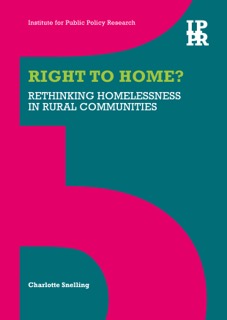
Homelessness across England is on the rise. Rates are high in urban areas and yet many households in rural areas are threatened with or experience homelessness, according to new research conducted by the Institute for Public Policy Research.

  • In 2015/16, 6,270 households were accepted as homeless in England’s 91 mainly and largely rural local authorities (LAs).
  • In 16 of these predominantly rural LAs, at least two in every 1,000 households was accepted as homeless.
  • In 2015/16, mainly and largely rural areas in England reported making 12,977 decisions on homelessness approaches – 11 per cent of local authority decisions, nationally.
  • From 2010 to 2016, mainly rural local authorities recorded a rise from 191 to 252 rough sleepers – an increase of 32 per cent. In largely rural areas there has been a leap of 52 per cent
  • The peculiarities of rural areas can make delivering services to prevent and relieve homelessness particularly difficult.

This research has found that central to addressing homelessness in rural areas will be making sure rural housing markets work for their resident populations by providing affordable accommodation across a range of tenures and types of home. For homelessness itself, the research starts to identify a number of things that could be pursued now, ranging from new rural-specific homelessness strategies to new models of partnership working, from improved monitoring and reporting to community-based service delivery options.

You can read the report ‘Right To Home: Rethinking homelessness in rural communities’ online, or download it here: http://www.ippr.org/publications/right-to-home

Café Customers Can Buy A Homeless Person A Meal

A Cardiff cafe is selling vouchers to customers that can be used to buy a homeless person a meal – and so far hundreds have been sold!

Granny Mac’s, on City Road in Cardiff, has sold hundreds of the vouchers that customers can pass onto a homeless person to use in the café. The scheme was all the idea of manager, Leeann Edwards, who read about similar schemes at other cafes and wanted to give it a go herself. They started four months ago after they saw homeless people on the street outside the cafe and wanted to do something to help.

So, for £3.80, customers can buy a ‘Mini Mac breakfast’ to give to those who may not have eaten for days – but the cafe will bump it up to a large breakfast for free. There are also different vouchers available – from bacon rolls to hot drinks and different sized breakfasts – so everyone can buy one to fit their budget.

Leeann said: “I’m not from Cardiff and when I started working here, I noticed there’s a lot of homeless people in City Road especially. I must have read it a long time ago about cafes doing it. I know they [customers] don’t really want to give money to people, they’d rather give them food. Not everybody’s got £3.80 and I understand that and I understand that people do want to give back to the community, so what I thought I’d do is I’ve just ordered a stand where I’m going to put different vouchers in.”


After working in youth clubs in deprived areas and at residential homes for people with mental health problems, Leeann wanted her new job at the cafe to get the community involved. She said: “I thought let’s come up with some ideas to make things a bit different to give back to the community, because I like to do charity work and that’s when we came up with the vouchers.”

But it’s not the only plan she has. Leeann now wants to offer the cafe, which is shut from 3pm, as a venue for people with autism to have parties. She said she would provide the cafe for free if the people brought along their own food.

She said: “I’m hoping it will take off.”

Good Samaritans Help Homeless Victims Of Arson Attack

Dozens of people in Bristol have come forward to help a homeless couple after learning that they were victims of an arson attack.

Samantha Carpenter and Glen Baker were left with just the clothes they were wearing when their tent and all their belongings were razed to the ground. Police and firefighters said they were investigating and that the incident was suspicious. It comes less than another homeless person’s tent was burned down by arsonists in Castle Park, Bristol. The Bristol Post reported yesterday that the couple had been struggling to find the items they needed for their day-to-day living.

But within hours of the blaze being reported on the Bristol Post website, dozens of people had offered their help. Some came forward with clothes, others with bedding and camping equipment. Multiple charities – including Restore and Feed the Homeless Bristol – have also stepped in to provide them with tents, clothing, towels, cutlery and other daily essentials.

There has also been an outpouring of support for the couple since the attack.

One reader wrote: “Why would anyone do this? What does taking everything away from people who already have nothing actually achieve, except more pointless misery?”

Rebecca Devine wrote on Facebook: “How awful! Doing their best to get themselves clean and some idiot does this. Hope the moron is found and held accountable. You wouldn’t burn down a house and this to them was their home.”

Firefighters were called to the field next to the old Sorting Office in Cattle Market Road around 12.30am on June 22, after reports of a fire. A crew from Temple Fire Station found the couple’s temporary accommodation ablaze, together with all their belongings.

A spokesman for Avon and Somerset police said: “The fire is being treated as suspicious.”